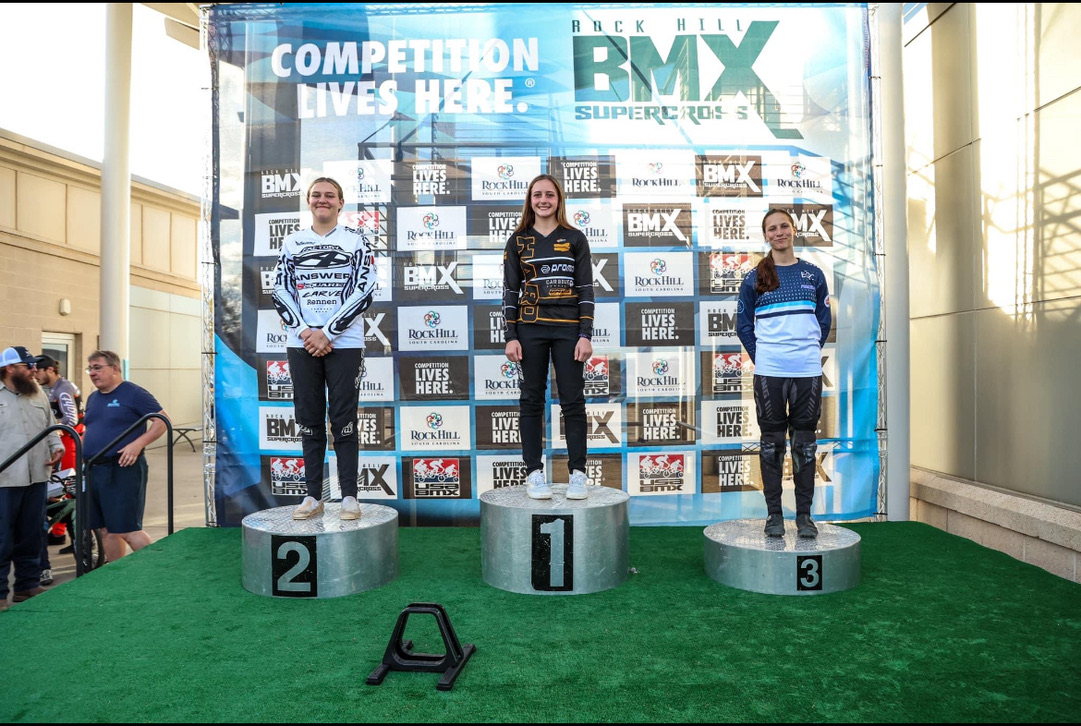

You've already invested thousands in travel, bikes, and race entries. Invest a fraction in the one thing that actually decides how you race on the weekend.

What BMX training is.
BMX training is the combination of three disciplines (gym work, sprint training, and track sessions) structured to produce faster performance on race day. It is not general strength and conditioning with a bike bolted on. It is a sport-specific system built around the demands of BMX racing.
BMX is a power-dominant sport. A race lasts roughly 30–40 seconds, decided by how explosive you are out of the gate and how well you repeat that explosiveness lap after lap. That reality shapes every part of proper BMX training:
Gym Training
Develops the strength and power base every on-bike output draws from. Maximum force production over hypertrophy.
Learn moreSprint Training
Converts gym strength into on-bike speed. Raw explosiveness, top-end speed, and pedal-stroke technique.
Learn moreTrack Sessions
Sharpens the skills that win races: gate starts, cornering, jumping, pumping, manuals, and race-day tactics.
Learn moreTraining any one of these in isolation leaves performance on the table. BMX training, done right, is the deliberate combination of all three, periodized so each block makes the athlete measurably faster.

Gym, sprint, and track.
Gym Training
“You can't fire a cannon from a canoe.”
BMX is a power sport, but power is built on top of strength. Strength is the limiting factor of power. An athlete can't be truly explosive if they lack the raw force production underneath the movement, no matter how fast they try to move. That's why the gym block exists: to build the strength foundation every sprint and every gate start draws from.
Riding alone can't produce maximum force. The bike limits the loads you can train against. The gym doesn't. Proper gym training develops the force production that on-bike work then converts into speed.
ECP uses Conjugate and Standard strength methods: max-effort work to build peak strength, paired with dynamic-effort work to convert that strength into speed. Olympic lifts are matched to each athlete's experience and goals. Riders who want to learn the full lifts get cleans and snatches with the catch; riders who don't stick with pulls and jumps that build the same power without the catch.
Velocity-Based Training (VBT) is integrated across both Olympic and traditional lifts, giving athletes exact bar speeds to dial in the loads to use on each set.
Sprint Training
“Go do some sprints” isn't a program. ECP sprint work is split into two distinct session types, each targeting a different part of race performance:
- Start + Acceleration covers box sprints, rolling starts, and short-distance work. Builds the explosive power that wins the first 30 feet of a race.
- Transition + Top-end covers flying starts and longer distances. Develops the top-end speed and pedal-stroke efficiency that carries through the first straight and beyond.
Riders with more sprint days add Practice Gate and Repeat Effort sessions.
Contrast tools come in when the block calls for them and the athlete has equipment or terrain access: resisted work (over-gear or uphill) for starts and acceleration, assisted work (under-gear or downhill) for transition and top-end. The two sides of the force-velocity curve, trained deliberately.
Sprint volume waves week to week across the 4-week block. Gate work comes with a stopping rule: once your times fall off your best, you're done for the day. No junk reps.
Bad weather doesn't kill a sprint day. Every block ships with structured rollers/trainer protocols (roller sprints, high-cadence spins, on/off/on patterns) and modified spin bike/Peloton sessions for athletes without outdoor options. The quality stays; the location changes.
Track Sessions
Watch enough BMX practice sessions and you start to see the same thing across every track: riders putting in reps week after week, doing roughly the same warm-up, roughly the same starts, a few laps with friends, and heading home. That loop is fine if you're riding for the love of it and racing locals for fun.
It stops being fine the moment you decide to travel. At Nationals, Gold Cup, or any race where you're spending real money on flights and entries expecting to win, podium, or make mains, you're racing athletes who've trained, not athletes who've just ridden. The gap shows the minute the gate drops.
Competing at that level takes a session structure built around the things that actually decide races: gates and first-straight speed, track speed, technical skill, and the conditioning to execute full-speed race laps without falling apart.
ECP track sessions rotate through four types across a 4-week block, each with a specific job:
- Skills Focused: manuals, pumping, jumping/rhythm, cornering. Three skill groups per session with dead-stop sprints leading the main work. Low CNS cost, high technical reward.
- Gate + First Straight: gate routines, attacking the first straight, half laps to finish. Builds the habits that win races.
- Track Speed: half laps, three-quarter laps, and full laps scaled by week. Primes with gate work before progressing to longer efforts.
- Full Laps: dedicated race-pace execution. Volume scales to race exposure. Athletes racing locally every weekend train fewer full laps, since race day already delivers them. Athletes with time between bigger events train more to keep race rhythm sharp.
Riders with one track day get a Combined Track Session that covers all of it, and race weeks include a pre-race practice session.
Every skill drill has a level. Manuals progress from singles through series, tap manuals, doubles, nose variations, and full straight linking. Jumping moves from tabletops and doubles to step-ups and back-to-back progressions. Riders get drills matched to their skill level, set from their USA BMX class and adjusted by their coach.
Race week compresses the whole structure. Full Laps drops out. Gate reps reduce. The nervous system is protected so the athlete arrives to the race sharp, not worn down.
Where Recovery Fits
Recovery isn't a separate pillar in the ECP system. It's engineered into every block through volume undulation. Training volume waves block-by-block and week-by-week, rising and falling on purpose. Even when a week dials back or a block eases off, the big-picture trajectory is forward.
That's distinct from tapering, which is short-term and race-specific: the planned reduction leading into a race. Undulation is the long-term framework that keeps athletes progressing; tapering is the short-term tool that delivers them to the gate fresh. Both systems run at once.
Development
Training by level.
No two athletes develop on the same timeline. Nine-year-olds who dominate on every stage sometimes fall off by fourteen. Riders who struggle through their early years sometimes turn into elite racers by their twenties. The common factor in the ones who last isn't talent. It's consistency. ECP's level system is built around that reality.
Training Experience Bands (Band 1–4) are the spine of the progression. Athletes move from Band 1 toward Band 4 (elite) by earning volume and intensity over weeks, months, and years. Each band unlocks more: higher-level plyometrics, more advanced exercises, greater workload tolerance. Nothing is given. Everything is earned.
Youth riders start with a focus on proper movement patterns and a foundation that holds up to the training years that come next, not trendy exercises pulled from a pro's Instagram. They learn the process before they chase the output.
Band 4 (elite) programming looks different. Adding volume indefinitely isn't sustainable. At that level, the training year is periodized around the competitive season, with workload rising and falling to match the goals of each block. Bands 1–3 follow the same principle with smaller swings.
The pace of progression is individual. The process isn't.

How programming adapts to your race schedule.
Race prep is one of the most mishandled parts of BMX training. Most riders either keep training flat-out until the weekend of the race and show up gassed, or take an entire week off and show up flat. Neither gives a real shot at peak performance when the gate drops.
ECP handles race prep as its own layer of the system: tier-aware, principled, and fully automated once an athlete enters their race calendar. Not every race deserves the same preparation, and programming adjusts across three event tiers:
State races, Gold Cup regionals, national-schedule weekends.
National championships, Gold Cup championships, key qualifiers.
Olympics, World Championships, World Cups, National Champs, Gold Cup Champs.
Athletes tag races at their chosen tier when they enter their race calendar. The system takes over from there.
Taper depth is matched to race stakes.
Tier 3 races get a focused race-week sharpening: a short taper that primes the athlete without pulling back enough to disrupt momentum. Volume trims, intensity stays high, and the athlete rolls into race weekend without losing the thread of their current block.
Tier 2 races trigger a longer arc that begins before race week. Gym volume steps down, advanced plyometric work is pulled back to protect CNS capacity, and the final race-week sharpening layers on top of that pre-race foundation. The athlete arrives with legs that have been gradually prepared, not abruptly decelerated.
Tier 1 races get the deepest and earliest adjustment in the system. Programming starts adapting weeks before the race, with tighter exercise selection, restricted high-CNS work, and a fully structured race-week protocol built to land the athlete at the gate at peak capacity.
Volume drops. Intensity doesn't.
Across every tier, taper means reduced volume, not reduced intensity. Main lifts stay heavy; they just cut to fewer working sets. Sprints stay explosive; they just cut to fewer reps. The idea is to preserve the power the athlete has built across the block, not to wash it out with easy work before the gate drops. Peaking is about removing fatigue, not removing the adaptations that generated the fitness in the first place.
Race week isn't improvised.
Race week runs on a structured protocol, not coaching discretion. The gym session, the sprint session, and the final track sessions are all prescribed based on the athlete's tier and race date. Nothing is left to guesswork on the week that matters most.
One race at a time.
The system only adapts to the athlete's nearest upcoming race. If you've got a state race in two weeks and a National Championship in six, the state race drives the current week's programming. The Championship takes over once the state race passes. No over-tapering for events too far out to matter, and no short-changing the race that's actually coming up next.
After the race.
Post-race isn't ignored. The system builds in a short recovery window following every race, enough to let the nervous system absorb the effort before the next block resumes. Training doesn't just restart full-throttle the next Monday.

Common BMX training mistakes.
The same mistakes show up across every track, every gym, and every training log. These are the five that do the most damage to progress, and the easiest ones to address once they're named.
Treating every track practice the same
Most riders put in real effort at practice. The gap isn’t work ethic: it’s structure. Without a defined purpose for every session, riders aren’t scratching the surface of what they could actually become. Structured track work has a purpose for every session: skills, gate + first straight, track speed, or full laps. When the purpose rotates, the athlete actually progresses. When it doesn’t, the athlete stays the same.
Unstructured sprint work
Running the same sprint session every week, picking arbitrary distances, resting too little between reps, or cramming too many reps into a single session. These all turn sprint work into conditioning. Sprint training is about maximum-quality efforts. That requires specific distances matched to the goal (start power vs. top-end), full recovery between reps, and a volume that changes week to week inside a block.
Lifting without intent
Strength work only produces power if it’s done with full effort on every rep. Slow, drifting reps on compound lifts build slow, drifting athletes. You have to train explosive to be explosive. Bad technique, underloading, and going through the motions are three of the fastest ways to put months of gym time into a hole.
Random or careless progression
Jumping up in weight too fast, creeping up too slowly, or loading random waves that don’t match a plan. All produce the same outcome: no measurable progression. Good training has structured progression, where each block builds on the last with deliberate increases in load, volume, or intensity tied to the athlete’s current capacity.
The exercise isn’t the program
There’s no shortage of good BMX-useful exercises. Squats, deadlifts, cleans, plyometrics: all legitimate, all valuable. But the exercise alone doesn’t tell you how to use it. How many sets and reps? How much weight? When do you increase load, and by how much? How long do you rest? What strength quality is this lift training? Where does it fit in a block (race week, off-season, pre-season, year-round)? Should band resistance be added? Every exercise has an entire programming framework behind it, and that framework is what actually produces the result. ECP answers those questions for every exercise in every program, so the athlete isn’t left guessing about the how.
FAQ
BMX training questions.
How many days a week should I train for BMX?
What is the difference between BMX training and general strength and conditioning?
How long does it take to see results from structured BMX training?
Can I train for BMX effectively without a gym or barbell?
At what age should a rider start a structured BMX training program?
Is online BMX training as effective as in-person coaching?

Ready to train like you mean it.
You've read the approach. You know what structured training looks like. Now comes the part where you either start doing it or you don't.
ECP programs come with everything you need to make the most of every session:
- Exact loads to use on every lift
- Box heights and plyometric prescriptions
- VBT speeds for velocity-based training (Gym Elite, Performance and Premium)
- Rest periods and coaching cues built into every exercise
- PR tracking with automatic load scaling: when a lift goes up, every future block reflects it
- Sprint time logging, plus automatic Sqorz track timing on Performance and Premium, so every session is measurable
Nothing beats showing up to the gate knowing you've done the work. That's what structured training delivers.